Sylvain Reynard

NY Times Best-Selling Author

  • Home
  • About
  • Passionflix
  • Books
    • Gabriel’s Inferno Series
      • Gabriel’s Inferno
      • Gabriel’s Rapture
      • Gabriel’s Redemption
      • Gabriel’s Promise
    • The Florentine Series
      • The Prince
      • The Raven
      • The Shadow
      • The Roman
    • The Man in the Black Suit
    • International Covers “Gabriel’s Inferno Series”
    • International Covers “The Florentine Series”
    • International Covers “The Man in the Black Suit”
  • Blog
  • FAQ
  • Contact

Measuring …

September 21, 2011

Dear Everyone,


I enjoy the website known as Goodreads. Through it, I’ve discovered many books I wouldn’t have encountered otherwise. The site also allows me to tell others what I’m reading.

At the moment, I’m re-reading “Measure for Measure” by William Shakespeare. You can download this for your Kindle for $0.99 or you can read it online through MIT. The title of the play seems to be a reference to a passage in Scripture, the Gospel according to St. Matthew 7:2,

“For with the judgment you pronounce you will be judged, and with the measure you use it will be measured to you.”


This passage raises all sorts of interesting questions, as does the play. But what I’m interested in is in the way Shakespeare presents the contrast between a person’s reputation (good or bad) and the person’s character. Who are the villains and who are the heroes and heroines of the play? What sort of message does Shakespeare communicate about how we judge our neighbours and ourselves?


I don’t promise to have answers to these questions but if you’d like to join the conversation you can do so on Twitter. I’ve recently finished Act II of the play and I welcome comments and discussion.


When I was writing “Gabriel’s Inferno” I was thinking about the contrast between the way a person is perceived and that person’s interior life. (Think about the Professor as he appears in Chapter 1 versus how he is presented in Chapter 2) Did his reaction to the telephone call change your perception of him?


I was also interested in the reactions readers would have to his behaviour in those two chapters, in contrast with the reactions of the other characters. Did Julia’s response surprise you?


If you’re interested in human behaviour, watch people and read literature. Both activities are tremendous well springs of information and insights into humanity.


I should mention that if you haven’t had a chance to read “Gabriel’s Inferno” and would like to, or would like a friend to read it, you can enter multiple giveaways during my book blog web tour.


Skyla11377 is offering a copy here.
Hanging with Bells! is offering a copy here.
Reading with Bakin_ Goddess is offering a copy here.

Books ‘n Kisses is offering a copy here.

There will be giveaways each day of the tour. I’ll be announcing them on Twitter and Facebook.

Many thanks to each of the blogs for reviewing my book and to KLB events for organizing the blog tour.
All the best and thanks for reading,
SR.
www.sylvainreynard.com

7 Comments Filed Under: Blog tour, Shakespeare

St. Francis, Paperbacks and Road Trips

September 13, 2011


Dear Everyone,


Recently, I had the pleasure of writing a guest post for Miss Tamie of The Book Hookup, on the subject of Muses. You can read the post and see the artwork I included here.
Last week, I mentioned a Book Club that put together a list of refreshments to accompany each chapter of “Gabriel’s Inferno.”
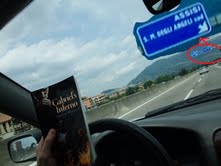
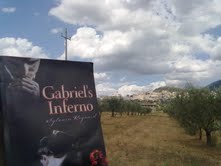
These week, I want to mention a reader who took her copy of my novel to Assisi. You can see the photographs she shared with me above.
Assisi is a special city to me and to many other people. It was the home of St. Francis and today, it houses the great Basilica, in which he is buried. You can view a short video of the crypt here.
St. Francis was not only a generous and holy man, he was very wise. He had compassion for the sick, generosity for the poor, a respect for nature and an affection for animals. You can read more about his life and what Dante thought about him here. Perhaps one of his best known writings is his prayer of peace:

“Lord make me
an instrument of your peace

Where there is hatred,
Let me sow love;
Where there is injury, pardon;
Where there is doubt, faith;
Where there is despair, hope;
Where there is darkness, light;
And where there is sadness, Joy.

O Divine Master grant that I may
Not so much seek to be consoled
As to console;
To be understood,
As to understand;
To be loved as to love.
For it is in giving that we receive,
It is in pardoning that we are pardoned.
And it is in dying that we are
Born to eternal life.”

You can listen to a musical version of St. Francis’ prayer performed by Sarah McLachlan, here.

If you have a photograph of your copy of “Gabriel’s Inferno” (either paperback or e-reader) that you’d like to send to me, you can do so by emailing me through this site, or sending it to me via Twitter or Facebook.

Where would you like to take the Professor? Where do you think he should go? I look forward to your pictures.

All the best and thanks for reading,


SR
www.sylvainreynard.com
PS. The lovely ladies of KLB Virtual Events are hosting a book blog tour for me from September 19 – October 3. There will be interviews, book reviews and giveaways. I’ll be posting more details soon.

11 Comments Filed Under: Assisi, photographs, St. Francis

Kindness is never wasted

August 30, 2011

Dear Everyone,


Kindles and Kindle applications allow readers to highlight lines in a book that they find particularly meaningful or poetic. Similarly, Goodreads allows readers to add quotes from an author or to favourite those quotations.


There are two quotations from “Gabriel’s Inferno” that are mentioned by readers more than any others. First, “Kindness is never wasted.” Second, “Sometimes goodness doesn’t tell everything it knows. Sometimes goodness waits for the appropriate time and does the best it can with what it has.”
I included these ideas intentionally, associating them both with the character of Julia Mitchell. Let me explain why.
Kindness is an underestimated virtue. It’s common in our society for people to champion tolerance, and rightly so. It’s less common for people to go further and advocate kindness. Toleration puts up with people and their idiosyncrasies, their flaws and imperfections. Kindness welcomes people. It honours a person’s humanity and dignity. It says, “You are worthwhile and valuable, just as you are.”
Kindness isn’t easy. But it is valuable, no matter what. Kindness is the right choice because it’s the right thing to do – not because it will win us friends, or fame or money. Thus, kindness is never wasted, even though the recipient of kindness might reject us or our actions or spit in our faces, for one reason or another. Kindness makes the giver vulnerable. It can change the life of the recipient.
Julia Mitchell is not a woman who has experienced much kindness in her life. Yet, she is kind. For all her flaws (and she has many), she chooses to be kind. She chooses, even in difficult circumstances, not to hit back, not to curse, not to be bitter. Readers have had very strong reactions to her, but I think most would admit that her kindness is a virtue to be recognized and praised. As the author, I believe that the contrast between the way she has been treated by and the way she treats others shows that she is a praiseworthy character.


I welcome your comments, as always.


All the best everyone and thanks for reading,


SR
www.sylvainreynard.com
PS. ETA – Sunny C has reminded me that Nook Color allows for highlighting, too. Thanks Miss Sunny.

23 Comments Filed Under: Julia, Quotations

Music – “Bésame mucho”

August 23, 2011

Dear Everyone,


As I mentioned in a previous post, I’m interested in the way music can help an author set a scene. In two scenes in “Gabriel’s Inferno,” the song Bésame mucho (recorded by Diana Krall), plays an important role. However, the meaning of the song shifts with the narrative.


You can listen to the song on my playlist. Here are the lyrics by Consuelo Velazquez, a Mexican songwriter and pianist who wrote the song at the age of sixteen, before she had been kissed:


“Bésame, bésame mucho
Como si fuera esta noche
La última vez


Bésame, bésame mucho
Que tengo miedo a perderte
Perderte después


Bésame, bésame mucho
Como si fuera esta noche
La última vez


Bésame, bésame mucho
Que tengo miedo a perderte
Perderte después


Quiero tenerte muy cerca
Mirarme en tus ojos
Verte junto a mi
Piensa que tal vez mañana
Yo ya estaré lejos
Muy lejos de ti


Bésame, bésame mucho
Como si fuera esta noche
La última vez


Bésame, bésame mucho
Que tengo miedo a perderte
Perderte después


Bésame, bésame mucho
Que tengo miedo a perderte
Perderte después


Que tengo miedo a perderte
Perderte después.”


Here is the English translation:


“Kiss me a lot


Kiss me, kiss me a lot,
As if tonight was
the last time.


Kiss me, kiss me a lot,
Because I fear to lose you,
To lose you later on.


Kiss me, kiss me a lot,
As if tonight was
the last time.


Kiss me, kiss me a lot,
Because I fear to lose you,
To lose you later on.


I want to have you very close
To see myself in your eyes,
To see you next to me,
Think that perhaps tomorrow
I already will be far,
very far from you.


Kiss me, kiss me a lot,
As if tonight was
the last time.


Kiss me, kiss me a lot,
Because I fear to lose you,
To lose you later on.


Kiss me, kiss me a lot,
Because I fear to lose you,
To lose you again.


Because I fear to lose you,
To lose you later on.”


Although the translation might help, it’s probably unnecessary. The music speaks for itself and that’s exactly the kind of song I was looking for in these scenes.


Thanks for reading (and listening).


All the best,


SR


www.sylvainreynard.com


PS. I mentioned author Heather Huffman and her support of WorldVision in a previous post. She has moved her books to Booktrope.com. You can read “Throwaway” for free on that site. Please consider donating to WorldVision if you read one of her books. I highlight a charity every day on my Twitter account. Today’s charity is WorldVision.


I was fortunate to be interviewed by Miss Tamie of The Book Hookup yesterday. You can read the interview here. In it, I mentioned a book club that has compiled a drinks list for each chapter of “Gabriel’s Inferno.” I’ll be sharing part of that list with you soon.
Thank you to Didimarble for more information on Consuelo!

9 Comments Filed Under: Charity, interview, Music

Dante, Sex and God

August 16, 2011

Dear Everyone,


There is a scene in “Gabriel’s Inferno” in which the main character gives a lecture at the University of Toronto on the topic of Lust in Dante’s Inferno. Professor Emerson is very familiar with lust and its various forms and some of his expertise emerges during his presentation.


In an interview that I did recently with Tigris Eden, (which you can read here), I identified Gabriel as a sensualist. He’s obsessed with the pleasures of the body – taste, touch, sound, smell, sight. You can see this in his choice of Scotch, food, sex, art, music, fine clothing and writing instruments, etc.


Julia is very different from Gabriel. She is a product of her upbringing and circumstances, but also of her choices. Rather than focusing on the pleasures of the body, she has favoured the pleasures of the soul – education, friendship, and love.


Throughout the course of the novel, the topic of sex is raised by different characters who espouse different views of it. Last week’s post was a glimpse into the music and ideas associated with Julia and her past. Several readers commented on the music and lyrics of the song. I enjoyed reading their reactions and so this week I welcomed readers to contact me via Twitter, Facebook or email to share their ideas about the connection between sex and God.


The response was overwhelming.


Many readers emphasized the connection between partners that emerges through sex – a connection of knowledge, intimacy, and giving. Some readers emphasized the transcendence or the sublime as it’s experienced in sex.


Readers identified themselves as coming from various different perspectives – some religious, some not. In all, I was surprised at the similarity among the comments and how reader’s reflections overlapped with my own views.


Over the course of writing a story that presents the redemption of sex as much as the redemption of a man, I’ve wondered about the relationship between sex, love and God. I’ll never be able to do justice to these connections in this short post, but I’ll present some of my reflections so far.


My suspicion is that sex offers human beings a glimpse of the transcendent in the way nature or human creations caused the Romantic poets to think of the sublime, or what Wordsworth termed “the spontaneous overflow of powerful feelings.”


If a Grecian urn, frost, or the ruins of an old abbey can inspire such reactions, how much more can sex? And if the powerful feelings elicited by nature or artifacts provoke us to think about our place in the world, how much more can sex provoke us to think of similar things and beyond?


What I have in mind here is the way that sex is all-consuming during the act and especially, during orgasm. Sex focuses all attention on the attainment of its goal – satisfaction. But one can also think of sex as a symbol of something else. The greatest of bodily pleasures could be seen as a foretaste of Dante’s Paradise,where one is known and loved intimately by the Divine and all one’s desires are satisfied, not just for moments but for eternity.


When Dante visits Paradise, he meets St. Bernard of Clairvaux (1090-1153). In description of the meeting Dante writes, “Though he had been absorbed in his delight, that contemplator freely undertook the task of teaching.” [Canto 32.1]


He goes on to describe Paradise this way,

“The King through whom this kingdom finds content

in so much love and so much joyousness

that no desire would dare to ask for more.” [Canto 32.61]


I’m sure everyone has their own idea of what heaven is like, if they believe in heaven. I have a fondness for Dante’s vision – that heaven is a place of absorbing delight, where everyone is content, loved and joyous, and one’s deepest and best desires are satisfied to the point where there is no more desire.


It sounds similar to sex, doesn’t it?


In the closing lines of the end of his Paradiso, Dante pens the following:


“But then my mind was struck by light that flashed

and, with this light, received what it had asked.

Here force failed my high fantasy; but my

desire and will were moved already—like

a wheel revolving uniformly—by

the Love that moves the sun and the other stars.” [Canto 33]

Through his visit to Paradise, Dante is given insight into the workings of the universe. Everything is governed by love. From a Dantean perspective, then, it doesn’t seem to be too great a leap to suggest that sex within the context of love is a picture or an image of Paradise.


Once again, I welcome your thoughts below. Thanks for reading,

SR

www.sylvainreynard.com

PS. If you have friends who are interested in reading “Gabriel’s Inferno,” please let them know about two contests in which they can enter to win a copy.

Also, you can read reviews of my book in languages other than English here.

20 Comments Filed Under: Dante, God, Sex

  • « Previous Page
  • 1
  • …
  • 62
  • 63
  • 64
  • 65
  • 66
  • 67
  • Next Page »
  • Goodreads
  • Facebook
  • Instagram
  • Pinterest
  • Twitter

Subscribe to Posts

Sign up below to receive Sylvain's latest posts sent to you by email.

Recent Posts

  • Advent Readalong – 2026
  • Audiobook Sale on Chirp
  • Stardust Over Florence
  • Planeta Libros
  • Lenten Readalong 6 – Holy Week

Request An

authorgraph

Get your e-book signed by Sylvain Reynard:

Request Authorgraph

The Gabriel Series

Archives

Connect with Sylvain

  • Goodreads
  • Facebook
  • Instagram
  • Pinterest
  • Twitter

About The Author

fluer-de-lisI am honoured to have had all three of my novels appear on the New York Times and USA Today Bestseller lists. I was a Semifinalist for Best Author in the 2011 and 2012 Goodreads Choice Awards. {More About Sylvain}

Sylvain Reynard © 2026Built with ♥ and Genesis WP by Priceless Design Studio